
What Is Mechanical Thrombectomy? Advanced Stroke Treatment Explained
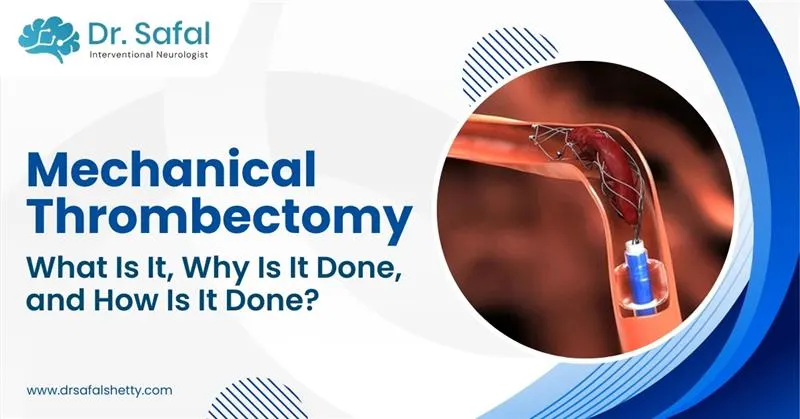
Mechanical Thrombectomy. What Is It, Why Is It Done, and How Is It Done?
As a stroke specialist in Bangalore, I see this often in my hospital. Patients walking into the emergency room, unable to walk, one side of their face drooping, or their arm hanging limp at their side. At this moment, we doctors don’t get the luxury of time. We have to act fast, as these are classic stroke symptoms.
In many stroke cases, especially the serious ones, a large blood clot suddenly blocks a major artery supplying the brain. When that happens, brain tissues beyond that blockage struggle to survive by starving for oxygen.
One of the revolutionary procedures we now have in modern medicine to handle such a situation is a procedure called Mechanical Thrombectomy. I know, it may sound complicated. But once you understand, it makes a lot of sense.
Let me walk you through what mechanical thrombectomy is, why it is done and how it is done as simply as possible.
First things first, what is mechanical thrombectomy?
Mechanical thrombectomy is a minimally invasive procedure that physically removes a blood clot from a blocked blood vessel in the brain. The word itself breaks down pretty simply: “thrombus” means clot, and “ectomy” means removal. So we’re talking about physically removing a clot from your blood vessel.
I often explain like this to my patients or their families. If a drain is blocked by a solid object, sometimes pouring water (medication) isn’t enough. You need a tool to go in and pull the blockage out. Mechanical thrombectomy does exactly that, but inside the blood vessels of the brain.
Why Do We Perform mechanical thrombectomy?
If you know a little bit about stroke treatment, you might have this question. When there is a clot-bursting medicine to dissolve the clot, why the need for mechanical thrombectomy? Yes. clot-bursting medicines(thrombolysis) do their job. But doesn’t work equally well for everyone.
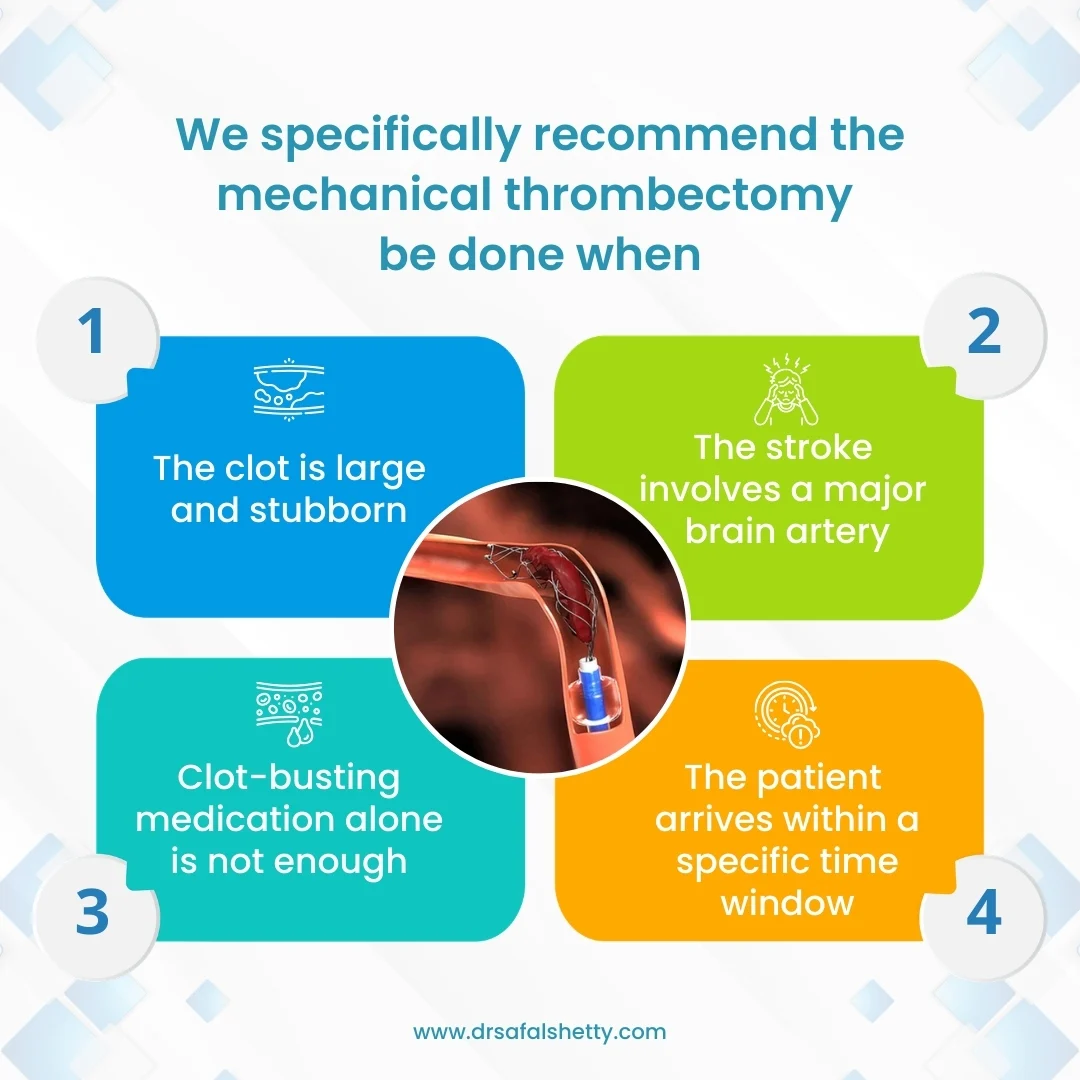
We specifically recommend the mechanical thrombectomy be done when
- The patient has come to the hospital within 6 hours of the onset of symptoms
- The stroke involves a major brain artery
We have a saying in neurology, “time is brain”. We choose mechanical thrombectomy when speed and effectiveness are needed to restore blood flow.
Mechanical thrombectomy is usually performed within 6 hours of stroke onset, but in selected patients, we can safely do it even up to 24 hours. As someone who performs these procedures regularly, I’ve seen patients rushed to our stroke-ready hospital and recover significantly after mechanical thrombectomy, sparing them from long-term disability.
How do we actually do it?
Alright, let me take you through the procedure step by step. It’s pretty fascinating.
Step 1: Getting access to the blood vessels
The procedure is performed in a specialised catheterisation lab(CATH LAB). The patient is either lightly sedated or given general anaesthesia, depending on the situation.
Here, we don’t need to open up the skull or make any large incisions. This is what we call a minimally invasive procedure. Instead, we make a small puncture, usually in the artery at the groin.
Through this tiny entry point, we insert a thin, flexible tube called a catheter and gently guide it through the blood vessels all the way up to the brain.
Step 2: Reaching the clot
Using real-time X-ray imaging, we carefully navigate the catheter up to the brain’s blood vessel where it is blocked. Once we reach the clot, we use special devices to remove it.
- Stent retrievers – tiny mesh-like devices that trap the clot
- Aspiration catheters – which suck the clot out using gentle suction
Sometimes we combine both methods for better results.
Step 3: Removing the clot
Once we secure the clot, we slowly and carefully pull the entire system back out, bringing the clot with it. Sometimes the clot comes out in one piece, sometimes in fragments. And almost immediately, blood flow is restored to the affected part of the brain. For us doctors, this is the most satisfying part, because we know we’ve just given the brain a second chance.
The whole thing typically takes less than an hour.
Step 4: Monitoring and recovery
After the procedure, the patient is closely monitored in a stroke unit or ICU. Brain scans are repeated, medications are adjusted, and rehabilitation planning begins early.
Now comes the most asked question, the recovery of the patient. Recovery depends on many factors, such as how quickly treatment was given, the intensity of the stroke, and the patient’s overall health. But mechanical thrombectomy significantly improves the odds.
Bottom line
If I have to summarise in one sentence, mechanical thrombectomy is a revolutionary procedure. Especially, it has changed the stroke treatment game and is considered one of the most effective stroke treatments. Both studies and our practical experience show that this treatment can mean the difference between severe disability and returning to a normal life.

Authored by Dr. Safal Sachidananda Shetty, an Interventional Neurologist & Stroke Expert in Bangalore with extensive clinical experience in stroke intervention, brain aneurysms, and complex neurovascular disorders. His mission is to educate, prevent, and provide advanced neurologic care using the latest medical innovations and minimally invasive procedures.