
Management of Acute Stroke | Early Treatment That Saves Lives
Management of Acute Stroke
Stroke is a kind of medical emergency where you can not wait and think, “let’s Google this symptom and find a solution”. When a stroke happens, everything suddenly becomes urgent. Every minute matters, quite literally. More importantly, the way a stroke is managed not only saves a life but also determines how much recovery a person makes after the treatment.
So let’s break it down in a simple way as to how exactly the management of an acute stroke is done, and what happens from the moment symptoms appear.
First things first: recognising a stroke
Before we even start talking about stroke management, let’s quickly know about the recognition, because recognising the symptoms as early as possible is the key to better acute stroke management. In the medical field, there’s this magical window called the “golden hour”, which is within 4.5hours for treatment to reverse the symptoms. This is when doctors can potentially minimise much of the damage.
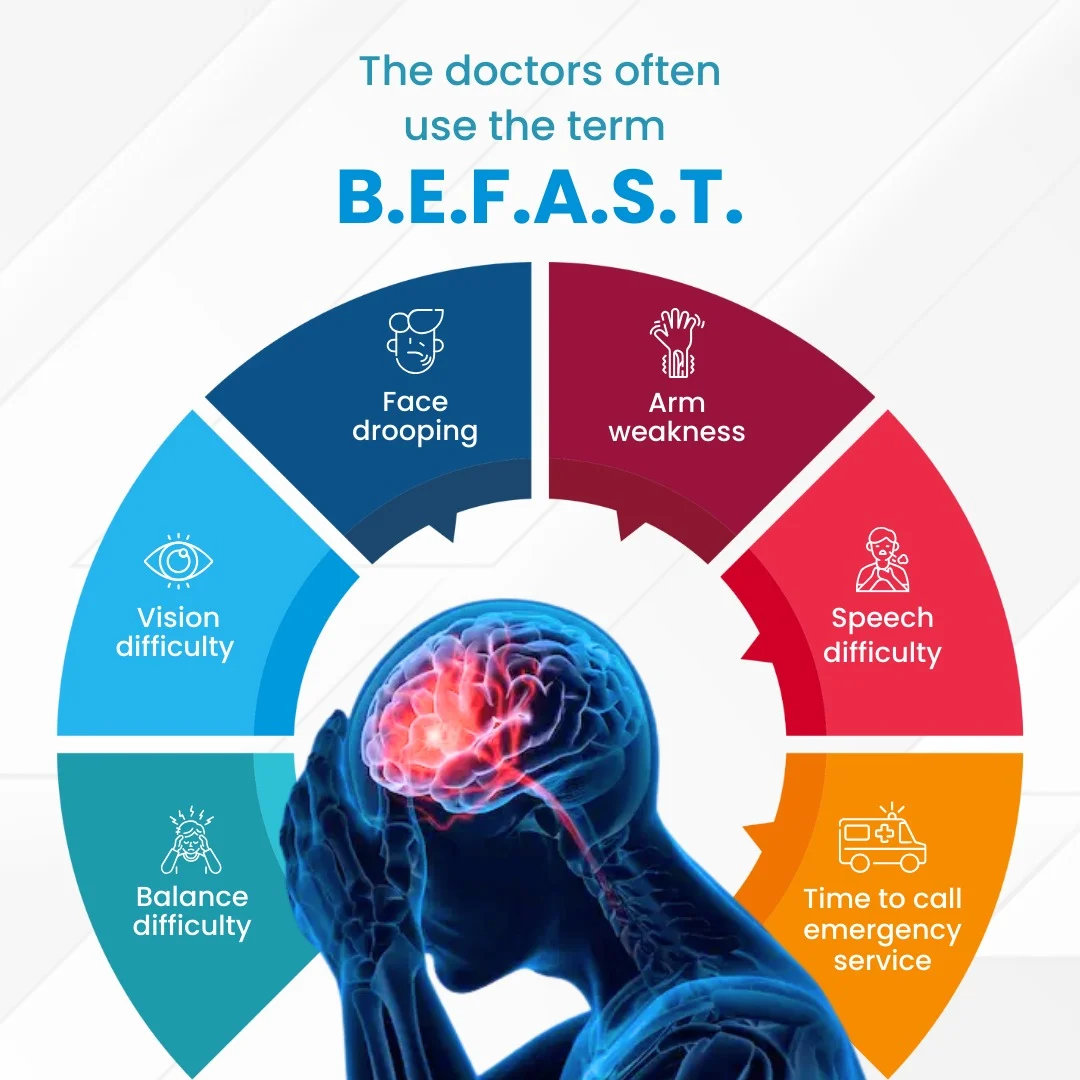
The doctors often use the term B.E.F.A.S.T
- B – Loss of Balance
- E – Loss of vision in the eye.
- F – Face: One side of the face drooping
- A – Arms: Weakness or numbness in one arm
- S – Speech: Slurred or difficult speech
- T – Time: Time to call emergency services immediately
If any of these symptoms appear, getting to the Stroke-ready hospital is the first and most important step in this acute stroke management process.
What happens after the patient reaches the hospital?
Here’s where things get critical. Once the patient reaches the hospital, the medical team immediately assess and do the brain imaging. Usually, doctors recommend a CT scan or a MRI scan, which confirms whether it’s a stroke and identifies the type. There are two main types of stroke:
- Ischemic stroke – caused by a blood clot blocking blood flow to the brain
- Hemorrhagic stroke – caused by bleeding in the brain
Recognising these distinctions matter a lot as the treatment for each stroke is completely different.
Managing an ischemic stroke
Most acute strokes are ischemic strokes. Here, the problem is a clot blocking the blood supply to part of the brain. The main goal is to restore blood flow as quickly as possible.
There is a clot-busting injection available which can be injected to break the clot and restore the blood supply. But there’s the catch. It only works within the 4.5hours within the golden window from when symptoms started.
For some patients with large clots blocking major vessel perfusing the brain, doctors may perform a mechanical thrombectomy, a minimally invasive procedure where the clot is physically removed using specialised tools. I know, it sounds intense, but with the right medical hand, this treatment saves a life.
Managing a hemorrhagic stroke
Hemorrhagic strokes require a very different approach. Here, the priority is to stop the bleeding and reduce pressure on the brain. The treatment involves reversing blood thinners, controlling blood pressure and reducing brain swelling. In serious cases, surgery might be needed to stop the bleeding or relieve dangerous pressure.
In both cases, the focus is on preventing further damage while giving the brain a chance to stabilise.
While all this is going on, there is a whole lot of other supportive care that keeps happening in the background. Blood pressure management, maintaining proper oxygen level and body temperature, controlling blood sugar and watching for complications like brain swelling or seizures, which play a huge role in acute stroke management. It’s a delicate balancing act that requires constant monitoring and adjustment.
After treatment care
Acute stroke management doesn’t end once the patient is stable. Now the focus shifts to the patient’s rehabilitation and support for their recovery process. Doctors may start medications to prevent clots, control blood pressure, manage sugars and manage cholesterol. At the same time, physical therapists, occupational therapists, and speech therapists begin working with patients to prevent complications and start the recovery process.
Managing an acute stroke is a race against time. The faster a stroke is treated, the more brain cells are saved, and the better the chances of recovery. Knowing the signs, acting without delay, and understanding what happens behind the scenes can make this frightening event a little less overwhelming and, most importantly, save a life.
FAQ
What is an acute stroke?
An acute stroke is a stroke that is happening right now or has just occurred. It is the most critical stage, where immediate medical treatment is needed to reduce brain damage and improve recovery.
Can a person fully recover after an acute stroke?
Recovery depends on how quickly treatment starts, the type of stroke, and the area of the brain affected. Many people recover well with early medical care and rehabilitation, while others may need long-term support.
What are the first warning signs of an acute stroke?
Common warning signs include sudden weakness on one side of the body, difficulty speaking, facial drooping, blurred vision, severe headache, or loss of balance. These symptoms appear suddenly and should never be ignored.
What is a stroke-ready hospital?
A stroke-ready hospital provides 24/7 specialised, rapid care for acute stroke patients, featuring immediate imaging (CT/MRI), specialised neurologists and fast-acting “clot-busting” thrombolytic medications. A hospital which is equipped to perform emergency procedures like mechanical thrombectomy within 6 hours of symptom onset to minimise brain damage.
Can acute stroke be prevented?
While not all strokes can be prevented, managing risk factors like high blood pressure, diabetes, high cholesterol, smoking, and leading a healthy lifestyle can significantly lower the risk.
Authored by Dr. Safal Sachidananda Shetty, an Interventional Neurologist & Stroke Expert in Bangalore with extensive clinical experience in stroke intervention, brain aneurysms, and complex neurovascular disorders. His mission is to educate, prevent, and provide advanced neurologic care using the latest medical innovations and minimally invasive procedures.
One Response