
Ischemic vs Hemorrhagic Stroke: What’s the Difference and Why It Matters
Ischemic vs Hemorrhagic Stroke: What’s the Difference and Why It Matters
STROKE. One of the life-threatening medical conditions that needs quick medical action. When speaking casually, we generalise stroke as a single condition. Like “He had a stroke” or “She is recovering from a stroke. But what’s less often known is that there are two major types of strokes. Ischemic and Hemorrhagic. While both strokes are medical emergencies requiring immediate attention, there are certain striking differences between the underlying mechanisms, risk factors and treatment approaches.
To bring you up to speed, let us take you through this simple and easy-to-read guide on the difference between ischemic and hemorrhagic strokes.
First, what exactly is a stroke?
A stroke occurs when blood flow to any part of the brain is interrupted. The brain cells suddenly stop getting the blood and oxygen they need and begin to die within minutes.
(know more about stroke and its early warning sign)
There are two main reasons why the brain may stop getting blood:
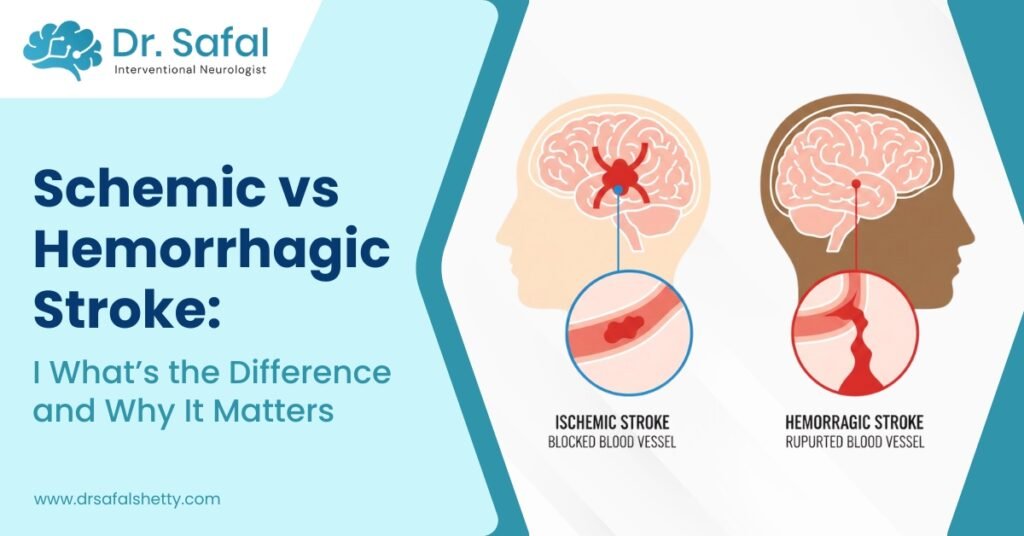
- A blockage in the blood vessel – ischemic stroke
- Rupturing of a blood vessel and bleeding in the brain – hemorrhagic stroke
1. Ischemic stroke
Ischemic stroke is a more common type of stroke, roughly accounting for 87% of all strokes. This happens when the blood vessels leading to the brain gets blocked. This clog cuts off blood flow to the brain, and the brain gets starved of oxygen.
Thus, it is emphasised that in the case of a stroke, the faster the blood flow is restored, the better the chance of limiting damage.
But why does a blockage happen?
- A blood clot that forms inside the vessel that supplies blood to the brain
- A blood clot may form in another part of the body (usually the heart) and travel to the brain
- Cholesterol or fatty deposits build up over time may narrow the vessels that lead up to the brain.
2. Hemorrhagic stroke causes
Hemorrhagic stroke is a less common type of stroke, but often more dangerous. Only 1 out of 10 strokes is Hemorrhagic. This type of stroke happens when a blood vessel bursts or leaks in the brain. This bleeding creates pressure, damages the brain tissue, and disrupts the normal blood flow.
But why do blood vessels rupture?
- Uncontrolled very high blood pressure that weakens the blood vessels over time.
- A weak spot in the brain blood vessel may lead to bleeding.
- Any injury that ruptures the blood vessels.
- Overuse of certain medications causes the blood to become too thin.
How are the symptoms different for Ischemic and Hemorrhagic stroke?
Both types of stroke cause similar symptoms, such as sudden weakness on one side, trouble speaking, difficulty walking, blurred vision or confusion. But a Hemorrhagic stroke has some extra warning signs, which are a sudden and very severe headache, loss of consciousness, vomiting, and more rapid deterioration.
Diagnosis and immediate care
Even though both types of strokes affect the brain tissue, they require a distinct treatment strategy. And getting the wrong treatment could be catastrophic.
When someone shows stroke symptoms, doctors quickly determine which type it is by doing a CT scan or MRI.
For Ischemic stroke treatment, upto 4.5 hours after stroke symptom onset is a critical time period and is referred to as the therapeutic window. The faster doctors can restore blood flow, the more brain tissue can be saved. Here, the medication is given to dissolve the clot or remove it using a procedure called Mechanical Thrombectomy.
In case of a Hemorrhagic stroke, the focus is on controlling bleeding and reducing pressure on the brain cells. Sometimes, the treatment involves emergency endovascular /microsurgery to repair the damaged blood vessel or remove accumulated blood.
When it comes to stroke, every second is a chance to save a life. Both Ischemic and Hemorrhagic strokes are serious emergencies and require immediate medical attention. The key difference between the two strokes is how the blood flow is interrupted, and the treatment will be administered accordingly.

Authored by Dr. Safal Sachidananda Shetty, an Interventional Neurologist & Stroke Expert in Bangalore with extensive clinical experience in stroke intervention, brain aneurysms, and complex neurovascular disorders. His mission is to educate and prevent stroke and provide advanced neurologic care using the latest medical innovations and minimally invasive procedures.