
Understanding Tremors: Causes, Types, Symptoms and Treatment
Understanding Tremors: Causes, Types, Symptoms and Treatment
Have you ever noticed your hands shaking slightly while holding a cup, writing, or reaching for something? Occasional shaking is common and may occur due to fatigue, high stress levels, or excessive consumption of coffee/tea. However, if the shaking is more frequent, noticeable, or starts interfering with daily life, it could indicate a neurological symptom called a tremor.
It is an involuntary, rhythmic motion of some parts of your body. While tremor is usually linked to hand movements, it may also occur in the head, arms, legs, speech muscles, etc.
Let’s understand tremor, its causes, types, symptoms and treatment options in simple language.
What causes tremors?
There are various reasons for tremor, ranging from temporary factors to underlying neurological conditions.
Stress, anxiety, lack of sleep, excessive caffeine, certain medications, and low blood sugar are some of the factors that trigger tremors. Tremors can be caused by neurological conditions.
Some neurological conditions, including Parkinson’s disease, essential tremor, multiple sclerosis, stroke, and certain disorders affecting the cerebellum, can cause tremors. Tremor can also be caused by thyroid disorders as well as other metabolic diseases.
Sometimes, for some individuals, there might be no obvious reason for the tremor. It is particularly common among people who have essential tremor, as it runs in their families.
Types of tremors
Not all tremors look or behave the same way. Doctors generally sort them into a few categories based on when they occur and how they affect movement.
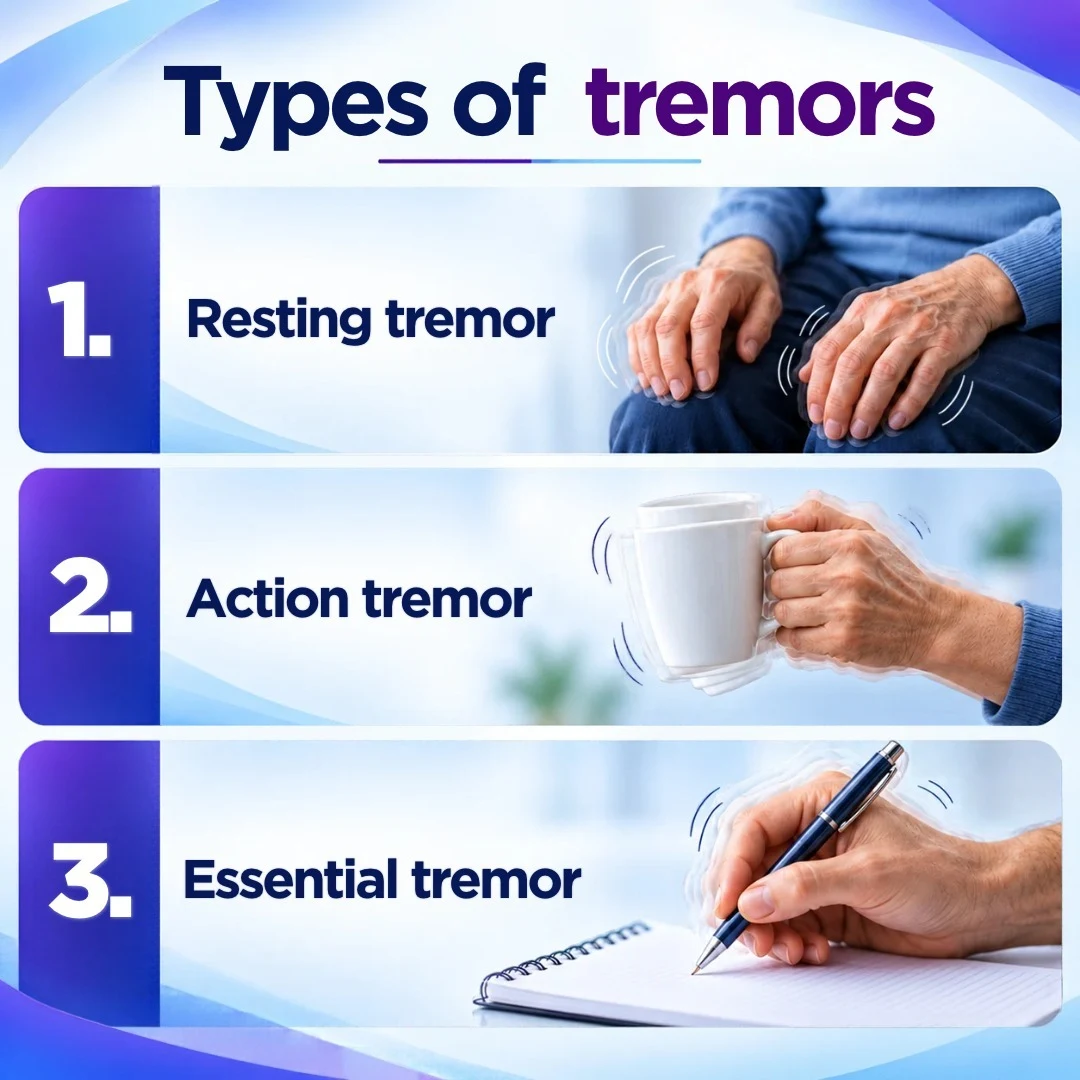
1. Resting tremor
Resting tremors occur while a limb or muscle is at rest and supported by gravity. It may become less noticeable when the person intentionally moves the affected limb. Resting tremor is often linked to Parkinson’s disease but doesn’t necessarily indicate someone has Parkinson’s disease if the person has resting tremor.
2. Action tremor
Action tremors occur due to muscle activity. It can be further described based on the activity that triggers it.
- Postural tremor, which appears when you hold a position against gravity (like stretching your arms out).
- Kinetic tremor, which shows up during movement, such as reaching for a cup.
- Intention tremor, which gets worse as you get closer to a target, often linked to cerebellar( part of hind brain) issues, the part of the brain involved in coordination and balance.
3. Essential tremor
This is the most common type overall. It usually affects the hands during activity, sometimes the voice or head, and tends to run in families.
What are the symptoms of tremors?
Rhythmic shaking or trembling is one of the most obvious symptoms of tremor. However, the way tremors show up can vary from person to person depending on the type and cause.
- Shaking in the hands, arms, head, legs, or voice
- Difficulty writing or using utensils
- Trouble holding a cup or other objects steadily
- Shaking that becomes worse during certain activities
- Tremors that appear when the body part is at rest
- Changes in handwriting or difficulty performing precise movements
- Aggravated by anxiety
The frequency and severity of tremors can also change over time. While some individuals have little to no effect on their day-to-day lives due to mild tremors, others might find doing everyday tasks more challenging. If the tremor is getting progressively worse, that’s your cue to see a neurologist rather than wait it out.
How are tremors diagnosed?
Tremor is not necessarily a disease in itself, so diagnosis mainly includes understanding what causes it.
We, neurologist, inquire when the shaking begins, which areas of the body are involved, whether it happens while resting or while moving, and if there is any particular thing that worsens it. We also ask about your medical history and any medications you are taking.
A detailed neurological examination can help assess muscle strength, coordination, balance, reflexes, and movement. Based on a diagnosis of the disease, we recommend lab tests like blood tests or imaging studies, as well as other necessary investigations.
How are tremors treated?
Treatment entirely depends on the underlying cause, the type of tremor, and how much it affects daily life.
If there is any medication or health problem causing this tremor, treating it might be an effective approach to reduce the shaking. We also recommend lifestyle modifications like getting enough rest, managing stress levels, and reducing excessive caffeine consumption, as it might be beneficial for certain individuals.
In cases like essential tremor, we might prescribe drugs to reduce its intensity. For some people who have severe tremor problems that don’t respond well to medications, deep brain stimulation (DBS) or other advanced therapies such as Magnetic Resonance guided Focused Ultrasound (MRgFUS) might be an appropriate approach to treat this.
Not every tremor requires treatment. If the shaking is mild and does not interfere with daily activities, a doctor may recommend monitoring it. .
When should you see a doctor for tremor?
A little shakiness after too much coffee is nothing to lose sleep over. But persistent, worsening, or activity-limiting tremors deserve a proper neurological evaluation. Early intervention helps to identify the cause and to rule out anything more serious early, when treatment tends to work best.
