
Interventional Neurology Treatment for Stroke & Brain Disorders | Advanced Neuro Care
Interventional Neurology. What Is It and What Do They Treat?
I often hear this question a lot in my clinic, “Doctor, I’ve been told I need an interventional neurologist. What exactly does that mean?” That’s a fair question. As a doctor, I understand that many people hear the term “interventional neurology” for the first time only when something serious happens. Like in the case of an acute stroke .
So let me use this space to explain everything about interventional neurology in the way I would explain if you were sitting in my clinic right now.
What exactly is interventional neurology?
Interventional neurology is a specialised branch of neurology that focuses on treating problems of the blood vessels of the brain and spinal cord using minimally invasive procedures. In simple terms, for diseases related to the blood vessels of the nervous system, rather than open brain surgery, we treat these neurological conditions by entering through a blood vessel, usually from the groin or wrist, and guiding tiny instruments all the way to the brain.
Who is an interventional neurologist?
We, interventional neurologists, are the doctors who are first trained in neurology and then undergo advanced training in catheter-based procedures involving the blood vessels of the brain and spine. So we understand how the brain works, what goes wrong during neurological disease and how to treat those problems from inside the blood vessels.
Why is interventional neurology so important today?
Now you’ve got the idea of what interventional neurology is and who interventional neurologists are. Now, let me paint you a picture of what exactly we do to make you completely aware of this medical jargon.
If there’s one condition where interventional neurology has completely changed outcomes, it’s acute ischemic stroke. When a patient comes into the emergency room with no movement in their right arm, face drooping, and no clear ability to speak within 4.5hours after the onset of symptoms, we immediately recommend a CT scan. If the scan shows a large blood clot blocking a major artery in the brain, then we come in with a ticking time clock. In conditions like ischemic stroke(a clot in the large artery of the brain), every minute of delay can cause permanent brain damage.
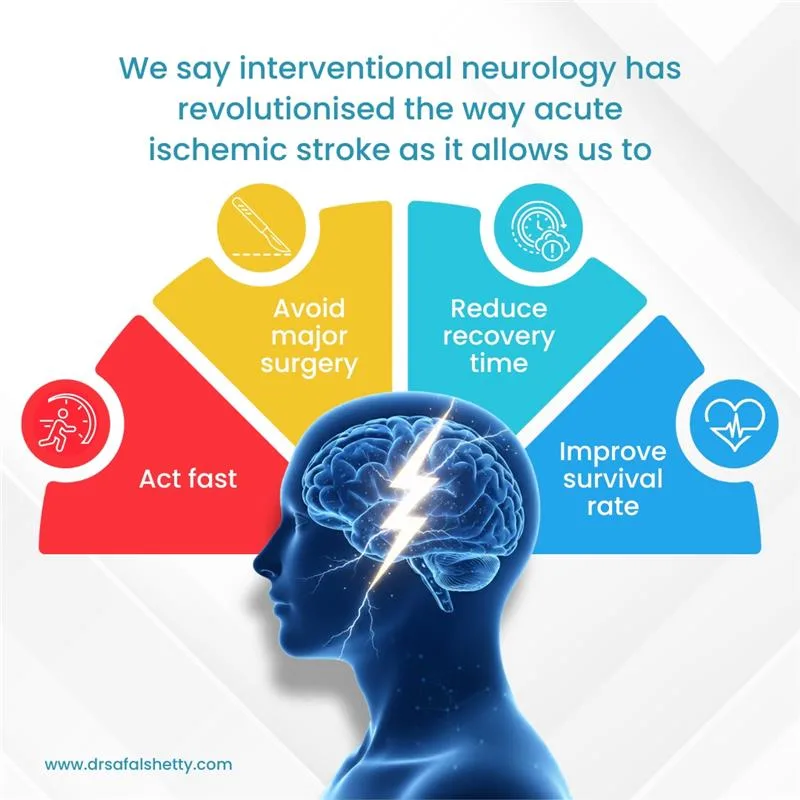
We say interventional neurology has revolutionised the way acute ischemic stroke as it allows us to
- Act fast
- Avoid major surgery
- Reduce recovery time
- Improve survival rate
Now comes the actual treatment part. We take the patient to a specialised operating theatre(CATH LAB). While the patient is under sedation, we insert a thin catheter from an artery in their groin all the way up to the blocked vessel in their brain. Using real-time X-ray imaging, we can see exactly where I’m going. Then, using a device called a stent retriever, we can actually grab that clot and pull it out.
The whole procedure might take 30 to 60 minutes. We call this a mechanical thrombectomy, and when done within the right time window, it dramatically improves outcomes. Pretty fascinating, right?
It's Not Just Strokes
While stroke treatment is a huge part of what we do, interventional neurology covers much more ground. Let me walk you through some of the other conditions we treat.
Brain Aneurysms: An aneurysm is a weak bulge in a blood vessel that can rupture and cause life-threatening bleeding. The aneurysm needs to be treated if ruptured or causing compression on the nearby structures in the brain. Earlier, these were treated mainly with open brain surgery. Today, we can treat many aneurysms by navigating a catheter to the aneurysm and filling it with tiny platinum coils or placing a special flow-diverting stent. This prevents the aneurysm from rupturing, or rerupturing ( if already ruptured) and reduces the compression symptoms without requiring open brain surgery.
Carotid Artery Stenosis/ Intracranial atherosclerotic disease( ICAD): Some patients have narrowing of the arteries supplying the brain, especially the carotid arteries in the neck. This increases the risk of stroke. In such cases, we do place a stent to open up these arteries and prevent future strokes. These procedures improve blood flow and reduce future stroke risk without major surgery.
Brain Arterio-Venous(AV) Malformations and Dural AV Fistulas: Malformations/ Fistulas are abnormal connections between arteries and veins in the brain, which can result in brain haemorrhage. These connections are fragile and can cause bleeding. These disorders need treatment if bleeding has occurred and if they are prone to bleeding. These disorders can be treated via minimally invasive methods where special catheters can be taken up to the area where these fistulas/malformations are present in the brain and can be closed using glue-like agents so that the further chance of bleeding can be completely stopped.
Why This Approach Matters
You might be wondering, why go through blood vessels instead of operating directly on the brain? Well, there are several advantages. First, there’s no need to open the skull, which means less trauma to the surrounding tissues, shorter hospital stays, and faster recovery times.
Second, we can reach areas of the brain that might be difficult or risky to access surgically. The brain is delicate, and sometimes the path of least resistance really is through the bloodstream.
Bottom line
Interventional neurology represents one of the most exciting advances in treating brain and spine vascular conditions. It is about treating complex blood vessel problems of the brain and spinal cord from the inside, using precision, speed, and minimal invasion, especially when every second counts.
FAQ
What is the procedure of an interventional neurology like for a patient?
Most interventional neurology procedures are done under local or general anaesthesia and require a small puncture, not large cuts. It takes a few hours and has shorter hospital stays compared to open surgery.
Is interventional neurology right for everyone?
Not really. Every patient is different, and the decision depends on the condition, its severity, the timing and the overall health of the patient.
What is the difference between a neurologist and an interventional neurologist?
A neurologist mainly diagnoses and manages neurological conditions using medicines and lifestyle guidance. An interventional neurologist, on the other hand, is trained to treat certain blood vessel problems in the brain using minimally invasive procedures, often through blood vessels, without open surgery.
Are interventional neurology procedures safe?
Like all medical procedures, there are risks, but these treatments are highly advanced and carefully planned. When performed by experienced specialists, they are often safe and lead to faster recovery.
How long does recovery take after an interventional neurology procedure?
Recovery is usually quicker compared to open surgery. Many patients are up and moving within a day or two, depending on the condition treated and their overall health.

Authored by Dr. Safal Sachidananda Shetty, an Interventional Neurologist & Stroke Expert in Bangalore with extensive clinical experience in stroke intervention, brain aneurysms, and complex neurovascular disorders. His mission is to educate, prevent, and provide advanced neurologic care using the latest medical innovations and minimally invasive procedures.